
Irrigation Pipe Installation in Snodland
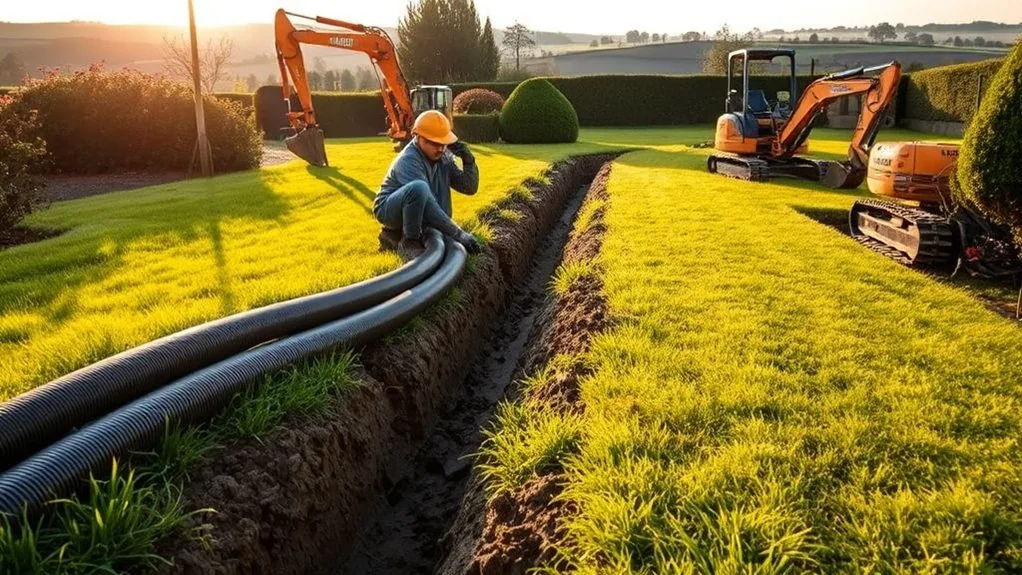
Struggling with inefficient or unreliable irrigation for your garden, grounds, or larger land? A professionally designed and installed pipe system tailored to your site’s levels, soil, and water pressure can improve coverage and reduce waste.
Call now for a fast quote or emergency callout in Snodland.
When you talk about irrigation pipe installation, you’re referring to the complete process of planning, laying out, and connecting a network of pipes that reliably transports water from a supply source to specific areas of your landscape or agricultural land. You’re defining flow requirements, pressure zones, and control points so water reaches each zone efficiently and uniformly.
You’ll evaluate gradients, soil type, and exposure, then select pipe materials—typically HDPE, PVC, or MDPE—based on pressure ratings, durability, and compatibility with fittings and valves. Trenching depth, jointing methods, and backfilling are specified to protect lines and prevent leaks. Correct installation supports water conservation by minimising losses through friction, evaporation, and breaks, ensuring your system delivers the required output with the lowest possible consumption and maintenance.
Sometimes it’s clear you need irrigation pipe installation when manual watering can’t keep pace with demand, water use is difficult to control, or pressure and coverage are inconsistent across your landscape. You’re likely ready to upgrade when you’re seeing plant stress, patchy lawns, or excessive runoff even though you’re watering regularly.
You should consider a designed system if you’re dealing with:
In these conditions, planned irrigation pipework gives you predictable output, better plant health, and a cleaner, more controlled landscape.
When you install an irrigation pipe system in Snodland, you’ll follow a structured process that starts with a precise site survey and hydraulic design tailored to your water supply and landscape. From there, accurate trench digging and layout guarantee correct depths, gradients, and zoning before pipes are laid, jointed, and connected to valves, controllers, and emitters. Finally, you’ll carry out pressure testing, performance checks, and adjustments before formal system handover so you understand operation, maintenance, and future expansion options.
How does a professional irrigation project in Snodland move from concept to a precise, buildable plan? It starts with a detailed site survey. You’ll have levels taken, existing services located, and usable water pressure and flow measured at source. Soil testing confirms infiltration rates and root-zone depth so pipe sizing, emitter selection, and zoning are technically correct.
Your contractor then maps sun/shade patterns, plant types, and microclimates to determine application rates for each zone. They’ll model demand against supply to prevent pressure loss and uneven coverage. A CAD or scaled layout is produced, showing pipe runs, control valves, drip lines, and sprinkler positions. Throughout, the design targets Water conservation, minimising overspray, runoff, and evaporation while protecting plant health.
Although the design exists on paper, the system only performs as intended if trenches are dug to the correct depth, alignment, and spacing. You’ll have each run marked with string lines and spray paint, then excavated to a uniform gradient that respects your site’s surveyed levels. Depth is set to protect pipes from traffic, frost, and UV, while preserving enough cover for long‑term pipe maintenance.
Before digging, you’ll assess soil type, utilities, and access routes for spoil. During excavation, you’ll compact sidewalls and base to promote soil stabilization and prevent trench collapse or pipe movement.
| Trench Element | Typical Consideration |
|---|---|
| Depth | Frost / load protection |
| Width | Pipe size + bedding clearance |
| Gradient | Consistent flow paths |
| Alignment | Avoids roots and services |
| Backfill Zones | Layered for stability |
With the trenches formed to the right depth and gradient, the focus shifts to placing and joining the pipework so water reaches each zone at the specified pressure and flow. You’ll select pipe materials—typically HDPE or MDPE for mains, with flexible polyethylene to feed laterals—based on operating pressure, soil conditions, and traffic loads.
Pipes are laid on a compacted, stone-free bed, following your design routes exactly to avoid pressure losses and dead legs. You’ll use compression or electrofusion fittings on mains, and barbed or threaded fittings on smaller lines, ensuring clean cuts, full insertion, and correct torque. Isolation valves, flush points, and pressure-regulating components are integrated to support water conservation, targeted delivery, and future maintenance with minimal disruption.
Once the pipework is in the ground and all connections are secure, the system moves into a critical commissioning phase where every component is tested under real operating conditions before you take ownership. Pressure tests verify pipe durability, while flow tests confirm each zone delivers uniform coverage without overspray, supporting water conservation and healthy plant growth.
We’ll calibrate controllers, fine‑tune run times, and check sensors so the system responds intelligently to Snodland’s changing weather. Any detected leaks, airlocks, or valve issues are resolved before sign‑off.
| Your Garden | Your Water | Your Confidence |
|---|---|---|
| Even growth | No wastage | Proven reliability |
| Lush colour | Lower bills | Documented tests |
| Protected soil | Responsible use | Clear handover |
You’ll receive a full walkthrough and maintenance guidance.
When you compare modern irrigation pipe installation methods to traditional excavation, the differences in efficiency, ground disturbance, and long‑term performance become immediately clear. With trenchless or minimally invasive techniques, you’re opening only narrow access points rather than continuous trenches, so existing planting schemes, lawns, and hard landscaping remain largely intact.
You also gain far greater control over hydraulic performance. Pipe depths and gradients can be fine‑tuned to integrate with Rainwater harvesting systems, ensuring consistent pressure across multiple zones. Accurate placement improves regulation of soil moisture, reducing dry spots and oversaturation. In contrast, traditional excavation often leads to uneven bedding, increased joint stress, and a higher likelihood of leaks, root ingress, and settlement, particularly in heavily landscaped Snodland gardens and grounds.
Although every site in Snodland presents different ground conditions and planting priorities, choosing a designed irrigation pipe installation delivers a consistent set of advantages: predictable water distribution, reduced wastage, and lower long‑term maintenance. You gain engineered control over flow rates, zoning, and operating pressures, so every bed receives exactly what it needs, when it needs it.
Key benefits include:
Whether you’re managing a small Snodland garden or a multi‑hectare commercial site, irrigation pipe installations apply the same engineering principles to very different performance requirements. In domestic settings, you’re typically optimising discreet pipe routes to protect garden aesthetics, maintain lawn uniformity, and deliver precise irrigation to beds, borders, and pots. You’ll focus on low‑pressure systems, simple zoning, and minimal disruption to existing hard landscaping.
On commercial premises—such as estates, sports grounds, business parks, or public landscapes—you’re dealing with higher flow rates, complex control logic, and integration with existing drainage and utility layouts. Here, hydraulic calculations, valve grouping, and maintenance access become critical. In both cases, you must evaluate wildlife impact, ensuring pipe placement and water delivery patterns support habitats, not disturb them.
From initial survey through to commissioning and handover, our irrigation pipe installation service in Snodland is built around rigorous site assessment, accurate hydraulic design, and disciplined on‑site execution. You’ll get a mapped layout of pipe routes, zoning, and valve locations based on pressure, flow rates, and elevation changes across your site.
We profile your soils, existing planting, and microclimates to define pipe diameters, emitter types, and spacing that stabilise soil health and root development. Trench depths, bedding, and backfill are specified to protect pipes and prevent damage. We integrate filtration, pressure regulation, and isolation points to maximise water conservation and simplify maintenance. Every system’s tested under operating pressure, with performance checks for uniform coverage and future expansion capacity.
Every detail of design and installation matters, which is why choosing the right specialist for irrigation pipe installation in Snodland directly affects system performance, water efficiency, and long‑term reliability. You need a team that understands soil profiles, local water pressure variations, and plant demands, then engineers a system that matches them precisely.
We calculate flow rates, zone layouts, and pipe diameters to prevent pressure loss and uneven coverage. Emitters, sprinklers, and controllers are specified to optimise Water conservation while protecting Garden aesthetics, with pipe routes planned to stay discreet yet fully serviceable.
You’ll get CAD-backed designs, robust components, and neat terminations at manifolds, valves, and control boxes, ensuring minimal maintenance, scalable expansion, and consistent irrigation across lawns, borders, and specialist planting.
You’ll naturally want clear answers on how long irrigation pipe installation will take, whether it’s more cost‑effective than conventional trench digging, and if your specific location in Snodland is covered. In this section, we’ll quantify typical installation timeframes, compare total project costs against traditional excavation, and specify our operational zones by postcode and service radius. This guarantees you can assess feasibility, budget, and scheduling with accurate, technical detail.
How long irrigation pipe installation takes depends on factors like system size, site access, soil type, and whether existing landscaping or hard surfaces need to be protected or reinstated. For a typical Snodland garden, you’re usually looking at one to three days from ground break to commissioning, assuming good soil compatibility and straightforward trenching.
| Project Scale | Typical Duration |
|---|---|
| Small garden zone | 0.5–1 working day |
| Medium lawn/bed mix | 1–2 working days |
| Extensive grounds | 2–4+ working days |
Survey and design, including water conservation calculations and pressure/flow checks, often take a separate visit. You’ll also need time for testing, flushing lines, setting controllers, and fine‑tuning emitter outputs so coverage, precipitation rates, and run‑times match plant demand and local soil infiltration rates.
While installation timeframes set expectations, most homeowners want to know whether laying irrigation pipe actually works out cheaper than simply hiring labour to dig or hand‑water long‑term. From a strict cost comparison perspective, you’ll usually see higher upfront spend on trenching, pipework, fittings, and control systems, but operating costs rapidly drop.
With a correctly designed system, you target root zones, reduce overspray, and cut water bills by 30–60% compared with manual watering or flood‑type hose use. That saving compounds each season, especially on larger lawns, borders, and sports or commercial grounds. There’s also a positive environmental impact: lower water consumption, fewer hose leaks, and more efficient use of pumped or metered supply, which all translate into long‑term financial and resource savings.
Wondering if our irrigation pipe installation team operates in your part of Snodland? We cover most of the county, including urban gardens, rural land, commercial grounds and equestrian or agricultural sites. Our service area spans Maidstone, Tonbridge, Sevenoaks, Ashford, Canterbury, Medway towns, coastal locations and many villages in between.
Coverage isn’t just about distance; we also consider local ground conditions, water pressure, and typical weather conditions in your area. These factors influence system design, pipe materials selection (e.g. MDPE, PVC, HDPE), frost protection depth and zoning strategy.
If you’re unsure, share your postcode, site size and current water source. We’ll confirm coverage, estimate travel logistics, and propose a tailored installation plan.
Yes, existing irrigation systems can be upgraded without replacing all the pipes if the pipes are durable and compatible with new components. The pipes should be pressure-tested and inspected for damage from UV exposure, corrosion, or impact. After confirming the pipe diameter, material, and pressure rating match new valves, controllers, and emitters, smart controllers, flow meters, pressure regulators, and more efficient sprinklers or drippers can be retrofitted using adapters and zone reconfiguration where necessary.
Local Snodland regulations require compliance with Snodland County Council policies and UK Water Regulations for underground irrigation pipe installation. You must map existing services before digging, maintain specified pipe depths, and use WRAS-approved materials. Backflow prevention devices are mandatory to protect the mains water supply. Utilities and tree roots must be avoided during installation, and runoff should be managed to minimise environmental impact. In certain sensitive areas, consent may be required for water abstraction, discharge, or working near watercourses and highways.
Seasonal weather in Snodland requires choosing irrigation pipes with high durability. Pipes must be frost-resistant and pressure-rated to prevent cracking during winter frosts. In summer, UV-stabilised materials are needed where pipes are exposed to sunlight. Persistent rainfall and clay soils increase erosion risk, so thick-walled pipes, secure joints, and proper bedding are essential. The system should also accommodate thermal expansion and tolerate freeze–thaw cycles.
Yes, irrigation pipes can be integrated with rainwater harvesting systems. Storage tanks are connected to a pumped mainline, which distributes water through pressure-rated pipes sized for peak flow and friction loss. Filtration should be included before the pipe network to prevent emitter blockage, and backflow prevention is needed if mains backup is used. The system should have level controls, overflow directed to sustainable drainage features like soakaways or swales, and isolation valves for maintenance and winterisation.
We offer tiered maintenance contracts after installation to provide ongoing support. These include installation warranties, scheduled inspections, and tasks such as pressure checks, leak detection, flushing, replacing worn fittings, recalibrating controllers, and optimising flow rates. You can select annual, seasonal, or pay-as-you-go support options with agreed response times and reporting on pipe performance and water-use efficiency.
Ready to see what a professionally designed irrigation pipe system in Snodland will cost for your property? Share a few technical details and we’ll produce a precise, itemised quotation tailored to your site and water source.
We’ll ask about your water pressure, intended irrigation zones, planting types, and preferences for water conservation so we can size pipework, specify emitters, and design efficient control layouts. You’ll receive a clear breakdown of materials, labour, and commissioning.
If you already have pumps, filters, or controllers, we’ll assess compatibility and factor in any required upgrades or equipment maintenance. Where helpful, we’ll outline options (e.g. automated vs manual control) so you can compare lifecycle cost, not just install price.
Get in touch today to request your detailed quote.